Beyond the Waistband: The British Makers Saying Goodbye to Elastic Forever
There's a particular kind of frustration that anyone who's kept clothes for more than a few years will recognise. The favourite linen trousers that fit perfectly for a season, then slowly — almost imperceptibly — begin to sag. The soft jersey skirt whose waistband goes baggy and never quite returns. The culprit, more often than not, is elastic. Synthetic, petroleum-derived, and stubbornly resistant to ageing gracefully, it's one of fashion's most overlooked problems. A small but growing community of British makers has had enough of it.
Across studios from the Scottish Borders to the Cornish coast, independent clothing makers are stripping elastic out of their garments entirely, reaching instead for drawstrings, horn buttons, hand-worked buttonholes, and traditional tapes. It's a change that sounds simple on paper. In practice, it demands a real rethinking of how clothes are constructed — and why.
The Problem Nobody Talks About
Elastic has been the backbone of garment construction since the mid-twentieth century, and it's easy to see why it caught on. Quick to apply, forgiving of variation, and cheap to produce, it became the default solution for waistbands, cuffs, necklines, and hemlines across every price point in fashion. But its convenience masks a significant cost.
Most elastic is made from a blend of rubber and synthetic fibres — polyester or nylon being the most common — and it sheds microplastics throughout its lifespan. Every wash, every stretch, every moment of wear releases microscopic particles into waterways and soil. When elastic degrades, as it inevitably does, it doesn't disappear. It breaks down into ever-smaller fragments that persist in the environment for centuries.
There's also the question of longevity. Elastic has a finite life. Exposure to heat, oils from the skin, and repeated laundering all accelerate its breakdown. A garment that might otherwise last decades is often made redundant by a waistband that gives out after five years. For makers who care deeply about building clothes that endure, this is a fundamental design flaw.
What They're Using Instead
The alternatives being championed by British artisans are, in many cases, centuries old — and none the worse for it.
Drawstrings are perhaps the most straightforward substitution. Makers working in natural fibres — cotton twill, linen tape, waxed cord — are threading drawstrings through casing channels in waistbands and cuffs, offering adjustability without any synthetic content. It's a method as old as clothing itself, and when the drawstring is made from durable natural fibre, it can outlast the garment it's attached to.
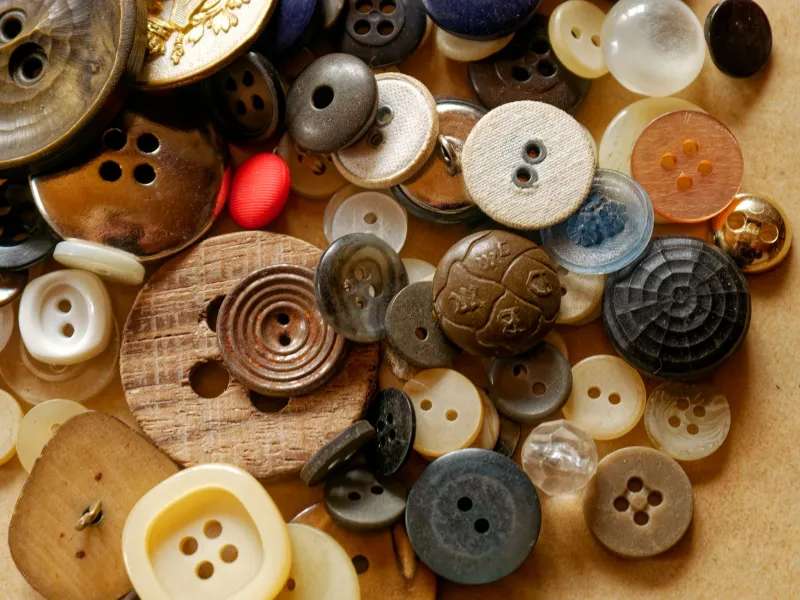
Buttons and buttonholes are making a significant comeback, particularly at the waistband. Several British makers are returning to the tradition of multiple-button fastenings on trouser and skirt waistbands — a method that allows for seasonal adjustment (that extra hole after Christmas is a feature, not a failure) and requires no synthetic material whatsoever. When paired with horn, corozo, or hand-carved wooden buttons, the result is a fastening that genuinely improves with age.
Hook-and-bar closures, once standard on tailored trousers, are also being revived. Brass or steel hooks attached to natural interfacing create a fastening that holds its form without any stretch component. Some makers are even producing their own cloth-covered hooks, wrapping metal findings in scraps of the same fabric used for the garment itself.
Lacing — the kind you'd associate with historical dress — is finding its way into contemporary designs too. On the surface it sounds theatrical, but makers are applying it with subtlety: a laced back panel on a blouse, a laced inset at the side of a skirt, offering fit adjustment without compromising the garment's natural fibre integrity.
The Technical Challenge
None of this is without its complications. Elastic became dominant for a reason — it compensates for imprecision. Remove it, and the maker has to get the fit right from the outset.
This is, in many ways, the point. Makers who have moved away from elastic speak about the shift as one that forced them to become better at their craft. Without the forgiveness of stretch, pattern cutting becomes more precise. Sizing becomes more considered. Many of these makers have moved towards a more measured, made-to-order approach — taking individual measurements rather than working to standardised sizes — which means the garment fits the person, not the other way around.
There's also the question of movement and comfort. Elastic provides a kind of passive ease — it moves with the body without the wearer having to think about it. Natural alternatives require a different approach to ease allowance in the pattern. Makers are building in generous cut, pleating, and careful construction to ensure their clothes move freely without relying on stretch. The result, many of them argue, is a garment that feels more considered — and more comfortable in the long run — than anything held together by a strip of synthetic rubber.
Clothes That Age on Their Own Terms
There's something philosophically aligned about this movement and the broader values it sits within. At Wildewood, we've always believed that the most beautiful things are those shaped by time and use — leather that develops a patina, linen that softens with every wash, wood that tells the story of its years. Clothes should be no different.
Elastic resists this kind of ageing. It doesn't soften or mature — it simply deteriorates, and then fails. A hand-stitched buttonhole, by contrast, beds in beautifully over time. A linen drawstring becomes more supple. A horn button gains a warmth and depth that a plastic toggle could never achieve. These are garments that reward loyalty.
Makers who've made the switch also note a change in how their customers relate to their clothes. When a waistband has three buttons and a hand-finished edge, people notice. They handle the garment differently. They're more likely to repair it, to pass it on, to think of it as something worth keeping. The removal of elastic, it turns out, is about much more than microplastics or longevity — it's about restoring a sense of intention to the clothes we wear.
A Small Change With a Long Reach
This isn't a mainstream movement yet. The vast majority of clothes sold in the UK still rely entirely on synthetic elastication, and there's no sign of that changing at scale any time soon. But the makers leading this shift aren't waiting for the industry to catch up. They're building their practice around the conviction that garments should be made to last — and that every component, down to the smallest fastening, should reflect that commitment.
If you've ever pulled on a pair of trousers and felt the waistband give in a way that felt slightly provisional — slightly temporary — you'll understand the appeal of an alternative. Clothes that hold their shape because they're cut well, finished carefully, and fastened with something that will still be working decades from now. That's not nostalgia. That's craft.
And in a world where fashion's environmental costs are becoming impossible to ignore, it's also, quietly, a form of rebellion.