Rock, Bark, and Pigment: The British Makers Reviving Lichen Dyeing for a New Generation
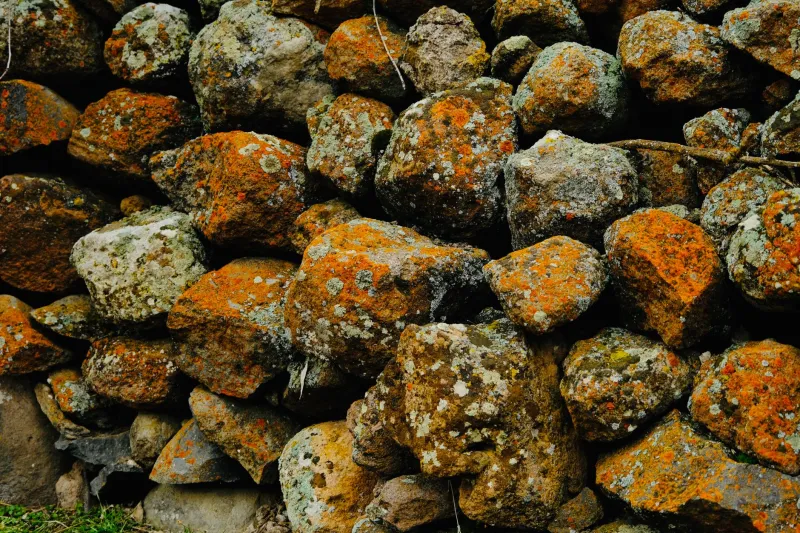
There's a particular kind of wonder that happens when you look at an old drystone wall and realise it's covered in living colour. Those silvery-grey crusts, those patches of mustard yellow and sea-foam green — they're not dirt, and they're not decay. They're lichen: one of the planet's most ancient and resilient life forms, and, as a growing number of British makers are rediscovering, one of its most extraordinary dye sources.
Lichen dyeing isn't new. It's ancient. Across Scotland, the Outer Hebrides, and the Welsh uplands, communities once relied on these slow-growing organisms to produce the warm russets, purples, and ochres that coloured everyday cloth. The Harris Tweed tradition, for instance, has deep roots in lichen-derived dyes — particularly from Parmelia saxatilis, known locally as crottle, which yields a rich, earthy brown that no synthetic has ever quite replicated. Then came the industrial revolution, cheaper alternatives, and a craft that all but vanished.
Now, quietly and determinedly, it's coming back.
What Exactly Is Lichen?
Before you can work with lichen, it helps to understand what you're actually dealing with — because it's genuinely fascinating. Lichen isn't a single organism. It's a partnership: a fungus and an alga (or sometimes a cyanobacterium) living together in a symbiotic relationship so intimate that neither could survive alone in the same conditions. The fungus provides structure and protection; the alga photosynthesises and feeds them both.
This partnership makes lichen extraordinarily tough. It grows on bare rock, on roof tiles, on the bark of oaks and rowans, in habitats where almost nothing else survives. Some specimens are thousands of years old. They're also, crucially, packed with complex organic acids — compounds like orcinol and lecanoric acid — that react with fibre to produce colour in ways that synthetic dyes simply can't mimic.
The resulting hues have a quality that's hard to describe until you've seen them in person: a depth, a warmth, a kind of visual texture that feels genuinely rooted in the earth rather than manufactured in a lab.
Foraging Responsibly: The Golden Rules
Here's where makers need to tread carefully — and most serious practitioners are emphatic about this. Lichen grows extraordinarily slowly. Some species gain just one millimetre per year. Stripping it indiscriminately from walls, woodland, or moorland would be genuinely destructive, and in many cases illegal under UK conservation law.
Responsible foraging means working only with fallen material — branches brought down by storms, stones cleared from field boundaries, bark from timber that's already been harvested. It means never taking from protected sites, SSSIs, or ancient woodland. And it means understanding your species before you pick anything at all.
Several makers recommend connecting with local natural dyeing guilds, many of which run foraging walks led by botanists or ecologists who can help identify both species and ethical collection points. The Association of Guilds of Weavers, Spinners and Dyers is a good starting point for anyone in England and Wales, while the Scottish Fibreshed community has built a particularly strong knowledge base around Highland lichen traditions.
From Stone to Skein: The Two Main Methods
Once you've gathered your lichen ethically, there are two principal dyeing techniques, each producing very different results.
The boiling water method is the simpler of the two. You simmer the lichen in water, strain out the plant material, and then add your pre-wetted fibre to the dye bath. This works particularly well with crottle and produces those warm, spiced browns the Harris Tweed makers knew so well. No mordant is needed — the dye bonds directly to protein fibres like wool and silk — which makes it one of the few truly mordant-free natural dye processes available to small-scale producers.
The fermentation method — sometimes called the ammonia fermentation or orchil process — is slower, stranger, and produces something altogether more dramatic. You ferment the lichen in an alkaline solution (traditionally aged urine, though modern makers tend to use household ammonia) over several weeks, watching the liquid shift through shades of pink, violet, and deep purple. The resulting dye bath can produce colours ranging from soft lilac to an almost bruised plum, depending on the species and the length of fermentation. This method works best with species like Ochrolechia tartarea and Lasallia pustulata.
Both methods require patience — which, at Wildewood, feels entirely appropriate. This is craft in its most elemental form.
Makers at Work: Voices from the Field
Among the artisans currently exploring lichen dyeing, there's a shared sense of quiet excitement. Textile maker Rowan Aldrich, who works from a converted outbuilding in the Brecon Beacons, describes the process as "genuinely humbling — you're not controlling the colour so much as negotiating with it." She works primarily with fallen oak bark and storm-gathered branches, producing small-batch yarn that she sells through independent craft markets and her own studio website.
"What draws people to these colours," she says, "is that they look like somewhere. Like a specific hillside at a specific time of year. That's not something you can manufacture."
Up in the Scottish Borders, weaver and natural dyer Catriona Mackay has been incorporating lichen-dyed wool into her tapestry work for nearly a decade. She's careful to emphasise the research side of the practice: "Before I pick anything, I photograph it, identify it, check the site. It takes time. But that time is part of the work."
The Environmental Case
For makers weighing up the environmental credentials of different dye methods, lichen offers some compelling advantages. No heavy metals are required as mordants (unlike many other natural dye processes, which rely on alum, iron, or copper). The dye bath itself is biodegradable. And the process uses no synthetic chemistry whatsoever.
The carbon footprint of responsible foraging is essentially negligible compared to the industrial supply chain behind even the most "eco-friendly" synthetic dyes. The colours also tend to age beautifully — fading slowly and gracefully rather than degrading into something dull and flat.
There are limits, of course. Lichen dyeing cannot scale. It will never supply a high street brand. But that's rather the point. These are colours for makers working in small batches, for independent designers who want their materials to carry genuine provenance, for anyone who believes that a garment can hold a landscape within its fibres.
Where to Begin
If you're curious about trying lichen dyeing yourself, start with research rather than foraging. Jenny Dean's Wild Colour remains an essential reference, as does A Dyer's Garden by Rita Buchanan. Online, the natural dyeing community is generous and knowledgeable — forums, Instagram accounts, and YouTube channels run by UK-based makers offer a wealth of practical guidance.
Then find your local guild. Go on a walk. Learn to see the walls and trees around you differently. Because once you start noticing lichen — really noticing it — you'll find it everywhere: on the roof of the village hall, on the gravestones in the churchyard, on the dry-stone walls lining the lane to the post office.
It's been there all along. Patient, resilient, full of colour. Waiting to be rediscovered.