Second Life, Second Stitch: The British Makers Hunting Down History's Most Beautiful Buttons
There's a particular thrill in turning a coat inside out at a car boot sale and finding, sewn neatly along the hem, a row of hand-carved horn buttons that nobody seems to have noticed. For most people, it's a curiosity. For a growing number of British artisans, it's the whole point of the trip.
Button hunting — the deliberate, patient sourcing of antique and vintage fasteners from second-hand clothing, estate clearances, haberdashery archives, and textile collections — has quietly become one of the more compelling corners of sustainable British fashion. These makers aren't just recycling hardware. They're preserving a material history that most of us have been walking past for years without a second glance.
What Gets Lost When a Garment Is Thrown Away
When a coat ends up in a landfill, or even a charity shop bin bag, the assumption is that the useful life of everything attached to it ends too. But buttons, by their very nature, outlast the fabric they're sewn to. A well-made button from the 1940s — bone, brass, Bakelite, or glass — can survive decades of washing, wear, and neglect with nothing more than a bit of tarnish to show for it.
The problem is that most people don't think to remove them. A garment gets donated or discarded intact, the buttons go with it, and if the piece doesn't sell, those fasteners disappear into a textile recycling stream that has no mechanism for separating out the beautiful bits.
This is exactly the gap that button curators are stepping into. Armed with patience, a good eye, and an encyclopaedic knowledge of British manufacturing history, they're intercepting these objects before they vanish — and giving them an entirely new purpose.
The Hunt Itself
Ask anyone who does this seriously and they'll tell you the sourcing is half the joy. Estate sales in rural Shropshire, textile fairs in Yorkshire, the back rooms of closing haberdasheries in market towns, online auction lots described only as "assorted sewing notions" — the geography of the button hunt is wonderfully unpredictable.
Some of the most remarkable finds come from old clothing factories and tailoring houses that have been clearing out their stock cupboards. Pre-decimal British manufacturing was extraordinarily detail-conscious, and surplus buttons were often kept in their original packaging for decades. Opening a box of 1960s deadstock coat buttons from a Midlands manufacturer feels, to those who care about this stuff, like a proper archaeological moment.
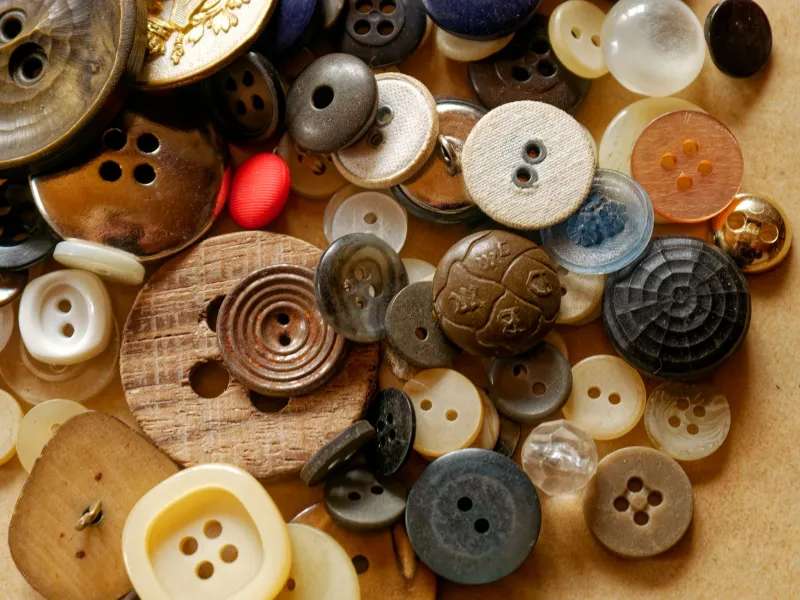
Others come from more personal sources. Inherited button tins — those biscuit tins full of snipped-off buttons that sat in every grandmother's sewing room — are a treasure trove of domestic manufacturing history. Buttons from school blazers, overcoats, uniforms, christening gowns, and Sunday bests, each one carrying a faint imprint of the life it belonged to.
Why These Buttons Matter
The craft argument for using vintage and antique buttons is straightforward: they are, in most cases, simply better made. Pre-1980s horn, bone, and shell buttons were carved and polished by hand or by semi-automated machinery that still required significant human oversight. The irregularities — the slight variations in thickness, the way the light catches a surface differently on each one — are features, not flaws.
But the cultural argument is just as compelling. British button-making has a surprisingly rich regional history. The Birmingham jewellery quarter once supplied the world with small metal buttons. Sheffield contributed steel. The textile towns of Lancashire and the West Riding of Yorkshire produced quantities of fabric-covered buttons that reflected the fashions of their era with remarkable precision.
When a maker in Bristol sews a set of 1950s pressed-glass buttons onto a newly constructed linen jacket, they're not just making a garment look interesting. They're threading a line between two moments in British textile history — one of production, one of reinvention — and that connection has genuine meaning.
Building a Circular Economy from a Biscuit Tin
The economics of button curation are modest but surprisingly coherent. At the small-batch end, individual makers source, sort, and sell curated sets of vintage buttons through their own studios or at craft fairs, often with handwritten notes describing the provenance of each set. At the slightly larger scale, a few specialist suppliers have built dedicated vintage button businesses, supplying independent dressmakers, slow-fashion designers, and costume departments who need something with more character than anything available new.
What makes this genuinely circular — rather than just nostalgic — is the way it closes the loop on discarded garments. Rather than stripping a piece of clothing for profit and dumping the rest, the best practitioners in this space work with textile recyclers and vintage dealers to ensure that the garments themselves are also repurposed, repaired, or responsibly processed. The button is the starting point for a broader conversation about what we keep and what we let go.
Some makers go further still, offering a button-removal service for customers who are parting with beloved old garments. The coat gets donated or repurposed; the buttons come back to the studio, get cleaned and catalogued, and eventually find their way onto something new. It's a small act of material respect, but it adds up.
The Stories Buttons Tell
There's an intimacy to buttons that other garment components don't quite have. A zip is functional. A seam is structural. But a button is chosen — often carefully, sometimes extravagantly — and it's touched every single day the garment is worn. Over time, the patina of a button reflects the life of the person who fastened and unfastened it.
This is what drives the more thoughtful makers in this space to document what they find. A set of carved wooden buttons from a 1930s tweed coat might come with nothing more than a question mark for provenance, but the wear patterns, the thread still looped through the shanks, the faint impression of a buttonhole on the surface — all of it tells you something about a life that was lived in that coat.
At Wildewood, we think that's worth preserving. Fashion that carries a story is fashion that resists disposability, not just in the environmental sense, but in the cultural one. When you fasten a jacket with a button that has already lived one full life, you're not just getting dressed. You're participating in something longer than yourself.
Where to Start
If this world appeals to you — and honestly, once you start noticing buttons, you can't stop — there are a few good entry points. Textile fairs like those run by the Knitting and Stitching Show circuit often include specialist haberdashery dealers with genuine vintage stock. Online, Etsy remains a reliable place to find curated vintage button sellers based in the UK, though the quality varies wildly and it's worth reading descriptions carefully.
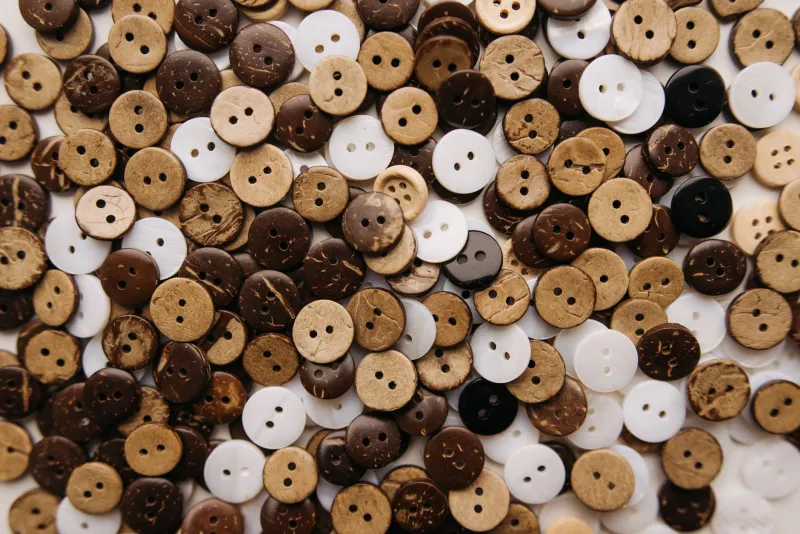
For sourcing your own, charity shops with dedicated textile sections are your best bet, followed by car boot sales and estate auctions. Look for natural materials — horn, bone, shell, wood, and early plastics like Bakelite and Casein — which tend to be both older and more interesting than their synthetic successors.
And if you're a maker already, consider this: the next time you're choosing fasteners for a piece you're proud of, it might be worth hunting for something that already has a history. The garment will be richer for it. And somewhere, a button that spent thirty years in a biscuit tin gets to be useful again.