Pleats with Purpose: How British Smocking Is Stitching Its Way Back into Fashion's Heart
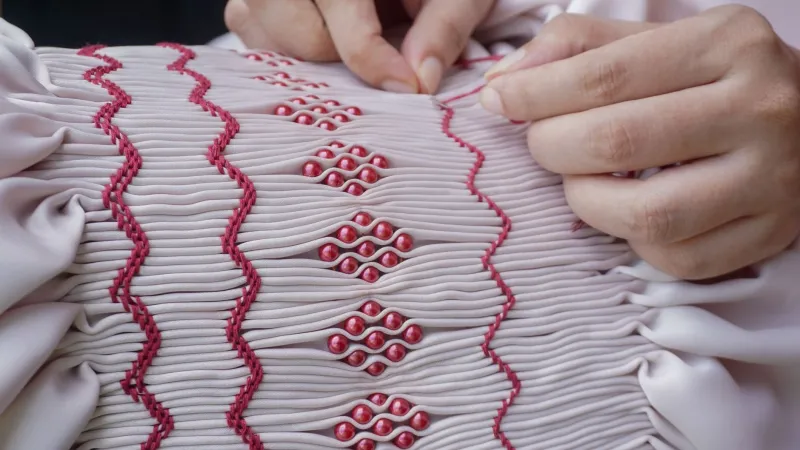
There is something almost meditative about watching a smocking pattern emerge from a plain stretch of fabric. Gather, stitch, gather again. The pleats fall into place with a kind of quiet inevitability, like a landscape slowly coming into focus. It takes hours — sometimes days — to complete a single bodice panel. And that, for a growing number of British makers, is precisely the point.
Smocking is having a moment. Not the nostalgic, fussy kind you might associate with your grandmother's curtains or a toddler's Sunday best, but something altogether more considered and quietly radical. Across independent studios from the Cotswolds to the Scottish Borders, a new wave of artisans is picking up the needle and rediscovering a craft that is, at its core, one of the most distinctly British textile traditions in existence.
Where It All Began
The story of smocking is woven into the fabric of British rural life. Agricultural workers wore heavily smocked garments — known simply as smocks — as practical workwear from at least the eighteenth century. The stitching wasn't just decorative; it allowed the fabric to expand and contract with movement, making it perfectly suited to a day spent in the fields. Regional variations developed organically, with different counties developing their own signature patterns. A shepherd in Wiltshire might wear a smock decorated with quite different motifs to a farm labourer in Kent.
By the Victorian era, smocking had migrated from the fields to the nursery, becoming synonymous with children's clothing — a shift that, for better or worse, cemented its association with innocence and tradition rather than craft and labour. The industrial revolution eventually rendered the hand-stitched working smock obsolete, and the art form retreated into the margins.
For much of the twentieth century, it survived largely through needlework guilds, craft magazines, and the occasional dressmaking pattern. Cherished, yes. But hardly visible.
The Makers Bringing It Back
What's changed is the context. The slow fashion movement, the resurgence of interest in handcraft, and a broader cultural appetite for things made with genuine intention have together created fertile ground for smocking's return.
Take makers like those working out of small studios in Herefordshire and the Welsh Marches — a region with deep historical ties to the smocking tradition — who are producing adult womenswear that treats the craft with the seriousness it deserves. We're talking structured linen dresses where the smocked bodice becomes the focal point, or oversized shirts in undyed cotton where honeycomb stitching runs across the shoulders like a quiet architectural detail.
The appeal for these artisans isn't simply aesthetic. Smocking is, by its very nature, anti-fast-fashion. You cannot rush it. You cannot outsource it cheaply. Each piece carries an irreducible number of hours within it, a kind of built-in honesty that mass production simply cannot replicate. When you hold a properly smocked garment, you feel the weight of that time. It changes your relationship with the thing.
"People come to us having never really thought about smocking before," one independent maker recently shared at a craft fair in Bristol. "But once they understand what they're holding — that someone sat with this fabric for the better part of a week — something shifts. They stop asking about the price and start asking about the process."
The Stitches Themselves
For the uninitiated, smocking encompasses a surprisingly wide vocabulary of stitches. Cable stitch, wave stitch, honeycomb, vandyke, diamond — each creates a different texture and visual rhythm across the gathered pleats. Traditional British smocking tended towards geometric regularity, the patterns often mirroring motifs found in nature: wheat sheaves, oak leaves, running water.
Contemporary makers are both honouring and expanding this vocabulary. Some work exclusively with heritage patterns researched from museum collections and regional archives. Others are developing entirely new combinations, pushing the craft into territory that feels genuinely contemporary without losing its essential character.
What they share is a commitment to working by hand. There are machines that can approximate smocking — gathering fabric mechanically and applying a kind of pleated texture — but experienced makers are unanimous that the result lacks the responsiveness and individuality of hand stitching. The slight irregularities, the way a stitch tightens fractionally more on one pleat than another, the organic quality of the finished surface — these are features, not flaws.
Styling Smocking Today
If you're new to wearing smocked pieces, the good news is that contemporary makers have largely shed the twee associations of the past. Today's smocked garments tend to work beautifully within a wardrobe built around natural fabrics and considered dressing.
A smocked linen blouse pairs effortlessly with wide-leg trousers in a contrasting natural fibre — think undyed hemp or a heavy organic cotton. The tactile quality of the stitching holds its own against the relaxed structure of the trousers, creating a balance between detail and ease. For cooler months, a smocked bodice under a loose wool jacket layers beautifully, the stitching visible at the neckline like a piece of wearable architecture.
Colour matters here. The craft tends to sing loudest on natural, relatively plain fabrics where the texture can take centre stage — pale ecru linens, soft sage greens, the kind of dusty rose that feels lifted from a hedgerow rather than a paint chart. Bold prints can work, but they often compete with the stitching rather than complementing it.
Accessories should, ideally, echo the handmade ethos. A smocked piece deserves to share a wardrobe with things that carry their own story — a hand-thrown ceramic button, a leather belt made in a small British tannery, a bag woven from natural rush or willow.
Why It Matters Now
There's a broader conversation happening here, one that goes beyond aesthetics or even craft preservation. Smocking, like so many traditional British needlework techniques, represents a form of knowledge that exists in hands and muscle memory as much as in pattern books. When the last generation of practitioners stops stitching, that knowledge doesn't simply move online — it dissipates.
The makers currently reviving this craft are doing something genuinely important. They're not recreating museum pieces; they're proving that an ancient technique can live comfortably in the present tense, that it can dress a modern body and speak to a contemporary sensibility without pretending to be something it isn't.
Slow, honest, rooted in a specific place and tradition — smocking is, in many ways, everything that the best of sustainable fashion aspires to be. The fact that it's also extraordinarily beautiful feels almost incidental.
Almost.
Explore handcrafted and artisan pieces at Wildewood, where every stitch has a story.