Needles Out, Walls Down: Why Making Your Own Clothes Has Become One of Britain's Quiet Revolutions
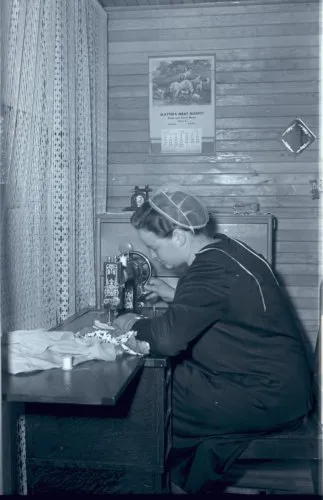
Photo: Mennonite Church USA Archives, No restrictions, via Wikimedia Commons
On a Tuesday evening in Peckham, eight people are crowded around two folding tables in a room above a pub. There's a woman in her sixties carefully unpicking a zip she's sewn in at the wrong angle. There's a twenty-three-year-old with a sleeve pattern pinned to a piece of calico, frowning in concentration. There's laughter, a bit of mild swearing, and a plate of biscuits that's been passed around enough times to be nearly empty.
This is a sewing circle. And across Britain, scenes like this one are multiplying in community centres, independent fabric shops, converted sheds, and borrowed kitchen tables — a grassroots resurgence of handmaking that's part practical skill revival, part social movement, and part act of quiet resistance.
Something Shifted During Lockdown (and Didn't Shift Back)
The pandemic gave many people their first serious encounter with craft. Knitting kits sold out. Sewing tutorials trended on YouTube. Fabric shops reported surges in online orders that they were wholly unprepared for. But what's interesting isn't the lockdown spike — it's what happened afterwards.
For a significant number of people, making things by hand didn't stay a coping mechanism. It became a practice. And increasingly, that practice has moved out of the home and into community settings, where the social dimension of craft has become just as important as the finished garment.
"I came for the sewing," admits Priya, a facilitator for a textile workshop in Sheffield that runs weekly sessions for adults aged eighteen to seventy-five. "I stayed for the community. And I think that's true for most of the people who come through our doors. The making is the excuse. The connection is the point."
This observation keeps surfacing in conversations with people involved in craft communities across the UK. The garment is almost secondary. What people are really after is the experience of making something with their hands in the company of others — something that the modern world has become remarkably efficient at eliminating.
Craft as Activism
For younger participants especially, joining a sewing circle or knitting cooperative carries an explicitly political dimension. Fast fashion — with its disposable price points, its exploitation of garment workers in the Global South, and its staggering environmental footprint — has become a genuine source of anxiety for many people in their twenties and thirties who are increasingly uncomfortable with consumer culture but unsure how to opt out of it.
Learning to make your own clothes is one answer. It's an imperfect one — fabric still needs to come from somewhere, and not everyone has the time or resources to sew their entire wardrobe. But the act of making a single garment changes your relationship with clothing in ways that are difficult to reverse.
"Once you've spent twelve hours making a shirt," says Aiden, who runs a men's tailoring workshop in Leeds, "you cannot throw a shirt away. The knowledge of what goes into it is in your body. You understand it differently."
This embodied knowledge is something that craft activists talk about a lot. It's the difference between knowing intellectually that fast fashion is harmful and understanding it in your hands — feeling the weight of the cloth, the resistance of the needle, the hours that accumulate in every seam.
For some communities, the politics go deeper still. Craft cooperatives run by and for women of colour, LGBTQ+ groups, and working-class communities are reclaiming traditions of making that were never really absent from their cultures — just rendered invisible by mainstream fashion narratives. A knitting collective in Birmingham that focuses on traditional West African textile techniques. A queer sewing group in Edinburgh that makes clothes specifically for bodies that high street sizing ignores. These are spaces where making becomes a form of self-determination.
The Mental Wellness Angle
Beyond the politics, there's growing evidence — and a mountain of anecdote — that handmaking is simply good for your mental health. The repetitive, rhythmic quality of knitting and hand-sewing has been linked to reduced anxiety and improved focus. The satisfaction of finishing something tangible in a world of endless digital tasks is, for many people, genuinely therapeutic.
"I have clients who come to our workshops specifically on their therapist's recommendation," says Gemma, who facilitates a textile arts group in Bristol. "There's something about working with your hands that quiets the noise. You can't scroll and sew at the same time. You're just... present."
Craft communities also provide a particular kind of social space that's become rarer: one where people aren't performing for each other, where the focus is on the shared activity rather than individual presentation, and where it's entirely acceptable to sit in comfortable silence for twenty minutes because you're counting stitches.
How to Find Your People
If you're curious about joining a craft community — or starting one — the landscape in the UK is richer than it's ever been.
Online directories and social platforms are the obvious starting point. Search for sewing groups and knitting circles on Meetup, Facebook Groups, or Instagram using your town or postcode. Many independent fabric shops — particularly the brilliant independents you'll find in most British cities — host or know of local groups and are usually delighted to point you in the right direction.
Local libraries and community centres are underrated resources. Craft groups often operate under the radar of social media, running quietly in council-owned spaces for years. It's worth asking at the desk.
Textile workshops and short courses are a great way to meet people if you're starting from scratch. Look for weekend intensives at craft schools — the likes of West Dean College in West Sussex, the London Centre for Book & Paper Arts, or any number of smaller regional makers' studios offer taster sessions that can double as a way of finding your community.
Starting your own is easier than it sounds. You need a space (a living room works fine to begin with), a group chat, and a date. Skills don't need to be equal — mixed-ability groups are often the most generative, because teaching someone else is one of the fastest ways to deepen your own understanding.
Come as You Are
One of the most quietly radical things about Britain's craft community revival is its resistance to perfectionism. These are not spaces where you need to arrive with a portfolio or a plan. They are, at their best, spaces where it's entirely fine to spend three sessions getting a zip right, or to decide halfway through a jumper that you actually want to make a bag instead.
The clothes you make in these rooms might not always be beautiful. They will always be yours — made with your hands, in community with others, at a pace that has nothing to do with trend cycles or seasonal drops.
In a world that moves very fast and sells you things very cheaply, that slowness is something close to radical. Pull up a chair. There are biscuits.