The Beauty in the Break: Why Visible Mending Has Become Britain's Most Meaningful Fashion Statement
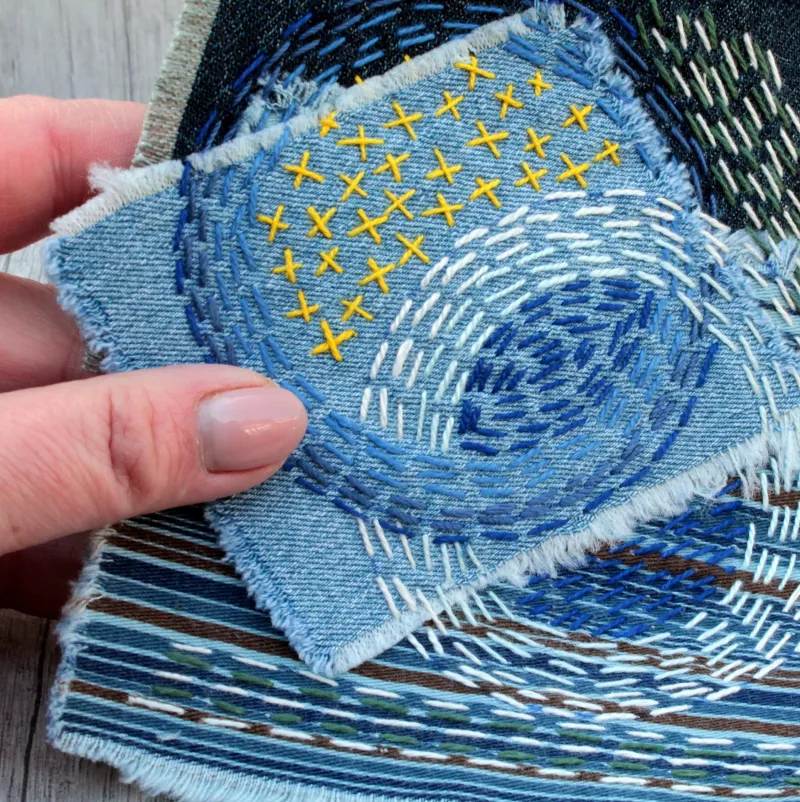
Photo: visible mending sashiko embroidery patch denim repair handcraft close up stitching, via i.pinimg.com
Somewhere in the last few years, a quiet rebellion has been brewing over darning mushrooms and embroidery hoops across the country. The garment that once would have been bagged up for the charity shop — the moth-eaten cashmere, the fraying denim, the beloved linen shirt with the iron-shaped hole — is being kept. Repaired. Transformed into something that wears its history openly, without apology.
Visible mending has arrived in Britain, and it's bringing with it a genuinely different way of thinking about what our clothes mean.
From Kintsugi to Knitwear
The philosophical roots here trace back to Japan. Kintsugi — the centuries-old practice of repairing broken pottery with gold lacquer, making the repair itself the most beautiful part of the object — has become something of a cultural touchstone in Western wellness and design circles. Its textile cousin, sashiko, uses dense running stitch patterns to reinforce and mend fabric, creating geometric designs that are as decorative as they are functional.
Both traditions share a central idea that feels almost radical by contemporary standards: that damage, repaired with care and skill, increases an object's value rather than diminishing it. The break is not something to hide. It's something to honour.
Britain has its own deep history of make-do-and-mend, of course — wartime necessity produced generations of people who could darn a sock in the dark. But what's happening now feels different from simple thrift. It's a conscious aesthetic and ethical choice, made by people who could easily afford a replacement and are deliberately choosing repair instead.
A Status Symbol for the Intentional Dresser
Let's be honest about something: there's a certain kind of visible mending that has become, in some circles, genuinely fashionable. A beautifully sashiko-stitched patch on the knee of selvedge denim, or a cascade of coloured running stitch across the elbow of a worn Harris Tweed jacket, signals something specific about the person wearing it. It says: I care about this. I paid attention. I have values that sit outside the throwaway economy.
Is that a form of status? Probably. But it's a status rooted in time and skill rather than spending power, which feels like a meaningful distinction. The most impressive mended garments aren't the expensive ones — they're the ones that show the most love.
Fashion has always been a language. What visible mending says is simply different from what a brand-new purchase says. It says: this thing has a life, and I'm part of it.
The Makers Offering a Way In
For anyone who's been curious but doesn't know where to start, a new generation of artisans and workshop leaders is making the practice genuinely accessible.
Harriet Voss runs mending circles from her studio in Leeds, mixing sashiko technique with more freeform embroidery approaches. Her sessions are deliberately social — participants bring their damaged pieces, share tea, and work through repairs together. "People arrive feeling guilty about the holes," she says, "and leave feeling proud of them. That shift happens in about two hours, and it's one of my favourite things to witness."
Her workshops are consistently oversubscribed, attracting everyone from students to retirees, and she's noticed a particular uptick in younger attendees who've never sewn before. "They're not coming because they grew up mending. They're coming because they've actively decided they want to."
In Edinburgh, Dougie MacAulay has built a small business around what he calls "garment archaeology" — working with clients to understand the full history of a piece before deciding how to repair it. He approaches each item almost like a conservator, and his repairs often incorporate materials that reference the garment's original context: a Shetland wool patch for a Fair Isle jumper, linen thread on a vintage tablecloth turned shirt.
"The repair should be in conversation with the original," he explains. "Not fighting it, not ignoring it. Responding to it."
Online, communities like the UK-based Visible Mending Programme have created spaces where thousands of people share their repairs, offer encouragement, and swap techniques. The hashtag culture around mending is, refreshingly, one of the more genuinely generous corners of the internet.
Starting Your Own Repair Journey
If you're ready to pick up a needle and try, here's the honest truth: it's more forgiving than you think.
Start with what you love most. The garments most worth mending are the ones you'd genuinely mourn losing. A favourite linen shirt, a well-worn jumper, a pair of trousers that fit perfectly. Emotional investment makes the effort feel worthwhile.
Get a darning mushroom. This simple wooden tool is the single most useful piece of kit for any textile repair. It holds fabric taut and gives you a curved surface to work against. You can find beautiful hand-turned ones from British craftspeople, or pick up a secondhand one for almost nothing.
Embrace running stitch first. Sashiko-style running stitch is the most accessible entry point — rhythmic, meditative, and forgiving of imperfection. A simple grid or wave pattern worked in contrasting thread over a thin patch gives you visible mending results with beginner-level skill.
Let imperfection be the point. The most beautiful repairs are the ones that are clearly handmade. Slightly uneven stitches, a patch that isn't quite square — these are features, not failures. They're the evidence of a human hand.
Think about colour. One of the joys of visible mending is the opportunity to add something unexpected. A pop of saffron yellow on a grey jumper, deep indigo stitching on cream linen — the repair becomes a form of personalisation.
Mending as a Way of Paying Attention
There's a reason so many people describe mending as meditative. The slow, repetitive motion of stitching creates a particular quality of focus — absorbed but calm, purposeful without urgency. In a world that constantly pushes us toward the new, sitting with something old and coaxing it back to wholeness is a quietly countercultural act.
At Wildewood, we've always believed that the things worth having are the things worth keeping. Visible mending is, at its heart, an expression of exactly that belief — that care and attention are the most radical forms of love we can show to the objects that share our lives. The broken thing, repaired with intention, becomes more itself. More honest. More ours.
Your worn-out jumper isn't a problem to solve. It's a story waiting to be continued.