What the Label Knows: The British Makers Turning Tags into Tiny Memoirs
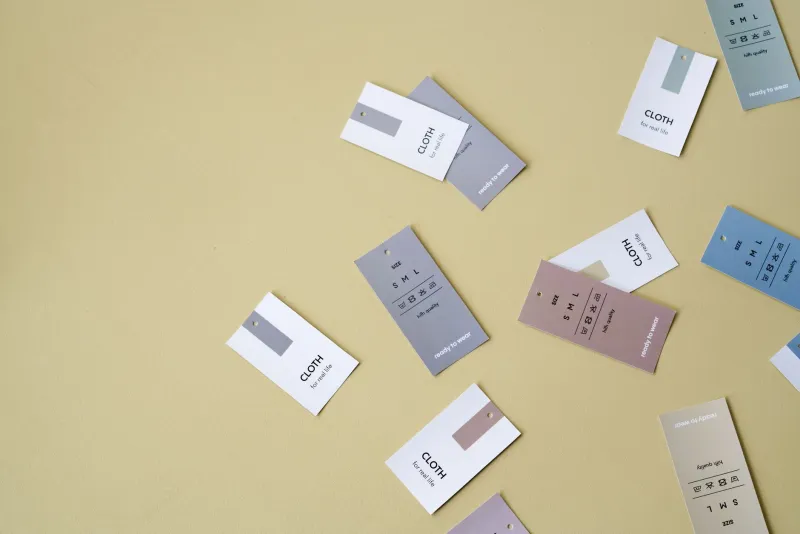
Most of us snip them out within minutes of getting something new. That scratchy little rectangle at the back of the neck, the one that tells you to wash at thirty and tumble dry low — gone before the garment's even been worn. But for a growing number of independent British makers, that label is the last thing they'd want you to remove. It's where the whole story lives.
We're in a moment where fashion is being asked to account for itself — where it comes from, who made it, what it cost the earth. And while that conversation tends to play out on social media or in sustainability reports, some of the most honest answers are being sewn into the quietest corners of a garment. If you know where to look.
More Than a Care Instruction
Spend any time with independent British designers and you start to notice something. Their labels aren't afterthoughts. They're considered, deliberate, often handwritten or hand-stamped — and they carry weight that no barcode could ever replicate.
Take Fern & Thread, a one-woman operation based in the Brecon Beacons. Every piece that leaves her studio comes with a small linen tag, hand-stitched with the name of the valley where the fabric was sourced and the season it was made. "I want whoever wears it to know they're wearing autumn in Powys," she told us. "Not just a coat. A place and a time."
It sounds romantic, but there's something genuinely radical in it. Fast fashion has spent decades making clothes anonymous — stripping out any trace of human involvement in favour of scalable production and forgettable branding. The handmade label does the opposite. It insists on specificity. It says: a person made this, in a real place, on a real day.
The Maker's Mark, Reinvented
The idea of embedding identity into craft is ancient. Medieval guilds used marks to authenticate their work — a stamp of quality, yes, but also of accountability. You knew who'd made it, and they knew you'd know. That tradition never entirely disappeared, but it got buried under decades of mass production.
What's happening now feels like a quiet excavation. Independent makers across Britain — from Orkney to Cornwall, from the Welsh borders to the East Midlands — are reviving the maker's mark in ways that feel personal rather than institutional. Some use initials. Others include coordinates, dates, or a single line of text that reads more like a dedication than a care instruction.
A knitwear designer working out of the Scottish Borders told us she includes a different phrase on every batch she produces — sometimes a fragment of a poem, sometimes something her grandmother used to say. "It's my way of signing the work without it feeling like a signature," she explained. "It's more like leaving a note."
Family Histories in the Hem
For some makers, the label is explicitly genealogical. A small tailoring studio in Bristol has been quietly including their family name — and the year the business was founded by the current owner's great-aunt — on every piece they make. It's not marketed as a heritage brand. There's no campaign around it. The label just carries the information, steadily, piece by piece.
"She started sewing during the war because there was no other choice," the owner said of her great-aunt. "I include her name because I think she deserves to be remembered in the work. That feels more honest than anything I could put on a website."
This kind of embedded history does something interesting to the relationship between maker and wearer. It creates a thread — sometimes literal — between people who may never meet, separated by decades or geography, connected only by a garment and a few words of cloth.
When the Label Becomes a Conversation
Not every message is retrospective. Some makers use their labels to open a dialogue with whoever ends up wearing the piece. A natural dye studio in Yorkshire includes a small card with each order explaining exactly which plants were used to create the colour and where those plants were grown. But they also sew a tiny tag inside the garment that simply reads: "If this fades, it's listening to your life."
It's a line that reframes wear and change as something to welcome rather than resist. Natural dyes shift over time — they respond to light, water, and use. By naming that process on the label, the maker is inviting the wearer into an ongoing relationship with the piece. You're not just owning it. You're part of its story now.
This is where the label-as-storytelling device gets genuinely interesting. It's not just about the maker communicating downward to the consumer. The best examples create a loop — they invite the wearer to contribute something back. To notice. To care. To perhaps, eventually, pass the garment on with its story intact.
Reading the Room (and the Seam)
If you've never paid much attention to your labels before, now might be the time to start. Next time you pick up something from an independent British maker — at a craft market, a small online shop, a studio sale — take a moment before you reach for the scissors. Read what's there.
You might find a name. A place. A season. A fragment of something that matters to the person who made it. You might find washing instructions and nothing else, which is fine — but increasingly, you'll find more.
The label, it turns out, is one of the last genuinely intimate spaces left in fashion. In a world of algorithmic feeds and optimised product pages, it's a square of fabric sewn into a quiet corner that nobody sees unless they're looking. And what it says, when someone does look, can be the most honest thing a garment ever tells you.
Why This Matters Right Now
There's a broader point here that connects to everything Wildewood believes about how we dress. Clothes made with intention deserve to be worn with intention. And intention needs language — it needs a way of being communicated that survives the transaction, the unwrapping, the first wash.
The garment label is that language. Small, durable, sewn in. It outlasts the packaging, the receipt, the Instagram post announcing the purchase. It stays in the seam, quietly holding whatever the maker chose to put there, for as long as the garment lasts.
Which, if it's well made and well loved, could be a very long time indeed.
Wildewood celebrates makers who put meaning into every stitch — including the ones you almost never see.